OGEA-101 Prüfungsunterlagen, OGEA-101 Lerntipps
Wiki Article
BONUS!!! Laden Sie die vollständige Version der Zertpruefung OGEA-101 Prüfungsfragen kostenlos herunter: https://drive.google.com/open?id=1HXVo-3QEMW6KkNQad6HMAN5In4mzc5tJ
Das erfahrungsreiche Expertenteam von Zertpruefung hat den effizienten Prüfungsfragen und Antworten zur The Open Group OGEA-101 Zertifizierungsprüfung entwickelt, die geneignet für die Kandidaten ist. Die Produkte von Zertpruefung sind von guter Qualität. Sie können sie als Simulationsprüfung vor der The Open Group OGEA-101 Zertifizierungsprüfung benutzen und sich gut auf die Prüfung vorbereiten.
Probieren Sie vor dem Kauf! Wir Zertpruefung sind verantwortlich für jeder Kunde. Wir bieten Ihnen kostenfreie Demos der The Open Group OGEA-101, somit können Sie nach der Probe unbesorgt kaufen. Außerdem können wir Ihnen garantieren, dass Sie keine Reue empfinden werden, nachdem Sie unsere The Open Group OGEA-101 Prüfungssoftware gekauft haben. Denn Sie können durch die Benutzung ihre Zuverlässigkeit empfinden. Dadurch bekommen Sie mehr Konfidenz angesichts der The Open Group OGEA-101 Prüfung.
>> OGEA-101 Prüfungsunterlagen <<
The Open Group OGEA-101 Lerntipps - OGEA-101 Prüfungsaufgaben
Gott ist gerecht, und jeder ist nicht perfekt. Wie wir alle wissen, ist der Wettbewerb in der IT-Branche sehr heftig.S o jeder will die IT-Zertifizierung erhalten, um einen Wert zu erhöhen. Ich denke auch so. Aber es ist zu schwierig für ich. Glücklicherweise habe ich die Dumps zur The Open Group OGEA-101 Zertifizierung von Zertpruefung im Internet gesehen. Dann brauche ich mich keine Sorgen zu machen. Die Fragenkataloge zur The Open Group OGEA-101 Prüfung von Zertpruefung sind wirklich gut. Sie sind umfassend und zielgerichtet. Wenn Sie auch ein Mitgleid der IT-Branche sind, fügen Sie schnell die The Open Group OGEA-101 Prüfung Fragenkataloge von Zertpruefung in den Warenkorb hinzu. Zögern Sie nicht. Die Fragenkataloge zur The Open Group OGEA-101 Prüfung von Zertpruefung sind Ihr bester Partner.
The Open Group OGEA-101 Prüfungsplan:
| Thema | Einzelheiten |
|---|---|
| Thema 1 |
|
| Thema 2 |
|
| Thema 3 |
|
| Thema 4 |
|
| Thema 5 |
|
The Open Group TOGAF Enterprise Architecture Part 1 Exam OGEA-101 Prüfungsfragen mit Lösungen (Q113-Q118):
113. Frage
Consider the following descriptions of deliverables consumed and produced across the TOGAF ADM cycle.
General rules and guidelines, intended to be enduring and seldom
amended, that inform and support the way in which an organization sets
about fulfilling its mission
The joint agreements between development partners and sponsors on the
deliverables, quality, and fitness-for-purpose of an architecture.
A document that is sent from the sponsoring organization to the
architecture organization to trigger the start of an architecture
development cycle
A set of quantitative statements that outline what an implementation
project must do in order to comply with the architecture.
Which deliverables match these descriptions?
1 Architecture Principles -2 Architecture Contracts - 3 Request for Architecture Work - 4 Architecture Requirements Specification
1 Architecture Contracts - 2 Architecture Requirements Specification - 3 Architecture Vision - 4 Architecture Principles
1 Architecture Requirements Specification -2 Architecture Principles - 3 Architecture Vision - 4 Architecture Contracts
1 Architecture Principles -2 Architecture Contracts - 3 Architecture Requirements Specification-4 Request for Architecture Work Explanation:
Antwort:
Begründung:
According to the TOGAF standard, the deliverables that match the descriptions are as follows:
1 Architecture Principles: These are general rules and guidelines, intended to be enduring and seldom amended, that inform and support the way in which an organization sets about fulfilling its mission1. They reflect a level of consensus among the various elements of the enterprise, and form the basis for making future IT decisions1.
2 Architecture Contracts: These are the joint agreements between development partners and sponsors on the deliverables, quality, and fitness-for-purpose of an architecture2. They are used to ensure that the architecture is implemented and governed according to the agreed-upon specifications and standards2.
3 Request for Architecture Work: This is a document that is sent from the sponsoring organization to the architecture organization to trigger the start of an architecture development cycle3. It defines the scope, schedule, budget, deliverables, and stakeholders of the architecture project3.
4 Architecture Requirements Specification: This is a set of quantitative statements that outline what an implementation project must do in order to comply with the architecture4. It defines the requirements for each architecture domain, as well as the relationships and dependencies among them4.
1: Architecture Principles 2: Architecture Contracts 3: Request for Architecture Work 4: Architecture Requirements Specification
114. Frage
Refer to the table below: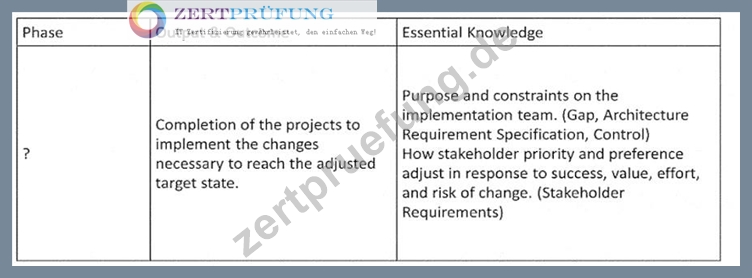
Which ADM Phase does this describe?
- A. Phase A
- B. Phase F
- C. Phase G
- D. Phase E
Antwort: C
Begründung:
The table describes the output, outcome, and essential knowledge of an ADM phase that oversees the implementation of changes necessary to reach the adjusted target state. This corresponds to Phase G, also known as Implementation Governance, which ensures that the architecture defined in earlier phases is realized, and it oversees the development and implementation of projects to align with this architecture. The essential knowledge required during this phase includes understanding constraints on the implementation team and adjusting stakeholder priority and preference in response to success, value, effort, and risk of change. References: TOGAF Version 9.1 - 1
115. Frage
Consider the following ADM phases objectives.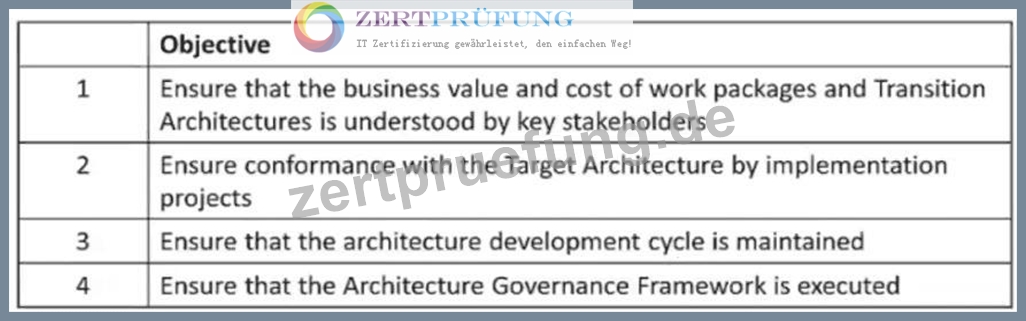
Which phase does each objective match?
- A. 1F-2G-3G-4H
- B. 1F-2G-3H-4H
- C. 1H-2F-3F-4G
- D. 1G-2H-3H-4F
Antwort: C
Begründung:
* According to the TOGAF Standard, Version 9.2, the ADM phases and their objectives are as follows1:
* Preliminary Phase: To prepare and initiate the architecture development cycle, including defining the architecture framework, principles, and governance.
* Phase A: Architecture Vision: To define the scope, vision, and stakeholders of the architecture initiative, and to obtain approval to proceed.
* Phase B: Business Architecture: To describe the baseline and target business architecture, and to identify the gaps between them.
* Phase C: Information Systems Architectures: To describe the baseline and target data and application architectures, and to identify the gaps between them.
* Phase D: Technology Architecture: To describe the baseline and target technology architecture, and to identify the gaps between them.
* Phase E: Opportunities and Solutions: To identify and evaluate the opportunities and solutions for implementing the target architecture, and to define the work packages and transition architectures.
* Phase F: Migration Planning: To finalize the implementation and migration plan, and to ensure alignment with the enterprise portfolio and project management.
* Phase G: Implementation Governance: To provide architecture oversight and guidance for the implementation projects, and to manage any architecture change requests.
* Phase H: Architecture Change Management: To monitor the changes in the business and technology environment, and to assess the impact and performance of the architecture.
* Requirements Management: To manage the architecture requirements throughout the ADM cycle, and to ensure alignment with the business requirements.
* Based on the above definitions, we can match each objective with the corresponding phase as follows:
* Objective 1: Ensure that the business value and cost of work packages and transition architectures is understood by key stakeholders. This objective is achieved in Phase H: Architecture Change Management, where the value realization and cost-benefit analysis of the architecture are performed2.
* Objective 2: Ensure conformance with the Target Architecture by implementation projects. This objective is achieved in Phase F: Migration Planning, where the conformance requirements and criteria for the implementation projects are defined3.
* Objective 3: Ensure that the architecture development cycle is maintained. This objective is achieved in Phase F: Migration Planning, where the architecture roadmap and iteration cycle are maintained3.
* Objective 4: Ensure that the Architecture Governance Framework is executed. This objective is achieved in Phase G: Implementation Governance, where the architecture governance processes and procedures are applied to the implementation projects4.
116. Frage
Which of the following best describes the need for the ADM process to be governed?
- A. To enable a fast response to market changes
- B. To verify that the method is being applied correctly
- C. To permit the architecture domains to be integrated
- D. To enable development of reference architectures
Antwort: B
Begründung:
According to the TOGAF standard, the need for the ADM process to be governed is to ensure that the architecture development and implementation activities are conducted in a consistent, coherent, and compliant manner1. Governance provides the means to verify that the method is being applied correctly and effectively, and that the architecture deliverables and artifacts meet the quality and standards criteria1. Governance also enables the management of risks, issues, changes, and dependencies that may arise during the ADM process1.
Some of the benefits of governing the ADM process are2:
*Improved alignment of the architecture with the business strategy and objectives
*Enhanced stakeholder engagement and communication
*Increased reuse and integration of architecture assets and resources
*Reduced complexity and duplication of architecture efforts
*Increased agility and adaptability of the architecture to changing needs and requirements
*Improved compliance and auditability of the architecture outcomes and outputs
117. Frage
According to the TOGAF standard, what term describes an individual with an interest in a system?
- A. stakeholder
- B. consumer
- C. sponsor
- D. lead architect
Antwort: A
Begründung:
According to the TOGAF Standard, 10th Edition, a stakeholder is "an individual with an interest in a system" 1. A stakeholder can be anyone who is affected by the system, or who can influence or be influenced by the system. Stakeholders can have different roles, perspectives, and concerns regarding the system, and they can be internal or external to the organization. Stakeholder management is a technique that helps to identify, analyze, and engage the stakeholders of an architecture project, and to address their needs and expectations 2. The other options are not correct, as they are not the term used by the TOGAF Standard to describe an individual with an interest in a system. A consumer is "an individual or group that uses a product or service" 1. A lead architect is "an individual who is responsible for leading the development of an architecture" 1. A sponsor is "an individual who provides funding and support for an architecture project" 1. Reference: 1: TOGAF Standard, 10th Edition, Part I: Introduction, Chapter 3: Definitions. 2: TOGAF Standard, 10th Edition, Part III: ADM Guidelines and Techniques, Chapter 24: Stakeholder Management.
118. Frage
......
Die The Open Group OGEA-101 Zertifizierungsprüfung ist schon eine der beliebten IT-Zertifizierungsprüfungen geworden. Aber für die Prüfung braucht man viel Zeit und Energie, um die Fachkenntnisse gut zu beherrschen. Im diesem Zeitalter, wo die Zeit sehr geschätzt wird, betrachtet man Zeit wie Geld. Das Schulungsprogramm zur The Open Group OGEA-101 Zertifizierungsprüfung von Zertpruefung dauert ungefähr 20 Stunden. Dann können Sie Ihre Fachkenntnisse konsolidierern und sich gut auf die The Open Group OGEA-101 Zertifizierungsprüfung vorbereiten.
OGEA-101 Lerntipps: https://www.zertpruefung.de/OGEA-101_exam.html
- OGEA-101 Prüfungsfragen ???? OGEA-101 Deutsch ???? OGEA-101 Online Prüfung ???? Suchen Sie jetzt auf ☀ www.deutschpruefung.com ️☀️ nach 【 OGEA-101 】 um den kostenlosen Download zu erhalten ????OGEA-101 Prüfung
- OGEA-101 Prüfungsübungen ⛪ OGEA-101 Deutsch Prüfung ???? OGEA-101 Antworten ???? Öffnen Sie ⏩ www.itzert.com ⏪ geben Sie 《 OGEA-101 》 ein und erhalten Sie den kostenlosen Download ????OGEA-101 Prüfungsfragen
- OGEA-101 Prüfungs ???? OGEA-101 Deutsch ???? OGEA-101 Probesfragen ???? Sie müssen nur zu { www.pruefungfrage.de } gehen um nach kostenloser Download von ➡ OGEA-101 ️⬅️ zu suchen ????OGEA-101 Zertifizierungsprüfung
- OGEA-101 Trainingsunterlagen ???? OGEA-101 PDF Demo ???? OGEA-101 Testfagen ✔️ ➠ www.itzert.com ???? ist die beste Webseite um den kostenlosen Download von ⏩ OGEA-101 ⏪ zu erhalten ❓OGEA-101 Zertifizierungsprüfung
- OGEA-101 Deutsch Prüfung ???? OGEA-101 Prüfungsübungen ???? OGEA-101 Trainingsunterlagen ???? Öffnen Sie die Webseite “ de.fast2test.com ” und suchen Sie nach kostenloser Download von ➥ OGEA-101 ???? ????OGEA-101 Zertifizierungsprüfung
- Die seit kurzem aktuellsten The Open Group OGEA-101 Prüfungsinformationen, 100% Garantie für Ihen Erfolg in der Prüfungen! ???? Suchen Sie auf ➡ www.itzert.com ️⬅️ nach ✔ OGEA-101 ️✔️ und erhalten Sie den kostenlosen Download mühelos ????OGEA-101 Online Test
- Die seit kurzem aktuellsten The Open Group OGEA-101 Prüfungsunterlagen, 100% Garantie für Ihen Erfolg in der TOGAF Enterprise Architecture Part 1 Exam Prüfungen! ???? Suchen Sie auf ➥ www.echtefrage.top ???? nach kostenlosem Download von ➤ OGEA-101 ⮘ ????OGEA-101 Lerntipps
- Die seit kurzem aktuellsten The Open Group OGEA-101 Prüfungsinformationen, 100% Garantie für Ihen Erfolg in der Prüfungen! ???? 《 www.itzert.com 》 ist die beste Webseite um den kostenlosen Download von ⏩ OGEA-101 ⏪ zu erhalten ????OGEA-101 Online Test
- OGEA-101 Zertifizierungsprüfung ???? OGEA-101 Examengine ???? OGEA-101 Prüfungsfrage ???? Suchen Sie jetzt auf { de.fast2test.com } nach 《 OGEA-101 》 um den kostenlosen Download zu erhalten ????OGEA-101 Testfagen
- OGEA-101 Zertifizierungsprüfung ???? OGEA-101 Prüfungsübungen ???? OGEA-101 Online Test ???? Erhalten Sie den kostenlosen Download von ( OGEA-101 ) mühelos über ▶ www.itzert.com ◀ ????OGEA-101 Prüfungsfragen
- OGEA-101 Neuesten und qualitativ hochwertige Prüfungsmaterialien bietet - quizfragen und antworten ???? Öffnen Sie die Webseite ➡ www.echtefrage.top ️⬅️ und suchen Sie nach kostenloser Download von 【 OGEA-101 】 ????OGEA-101 Deutsch Prüfung
- cyrusoezu811534.mdkblog.com, nicolemtxx873193.kylieblog.com, reganheat517952.atualblog.com, deborahttpx959618.wikiannouncing.com, carlyxsmm659746.bimmwiki.com, keithjtae155963.iyublog.com, kianatiyd926699.luwebs.com, prbookmarkingwebsites.com, www.stes.tyc.edu.tw, flynnkhxa740266.prublogger.com, Disposable vapes
P.S. Kostenlose und neue OGEA-101 Prüfungsfragen sind auf Google Drive freigegeben von Zertpruefung verfügbar: https://drive.google.com/open?id=1HXVo-3QEMW6KkNQad6HMAN5In4mzc5tJ
Report this wiki page